
After months of neighborhood opposition, the Chicago Cubs have received Plan Commission approval for a revised parking lot expansion at Racine Avenue and Grace Street. The project will reshape a portion of Wrigleyville near the former House of the Good Shepherd campus, but the final proposal is smaller than the team’s original plans.
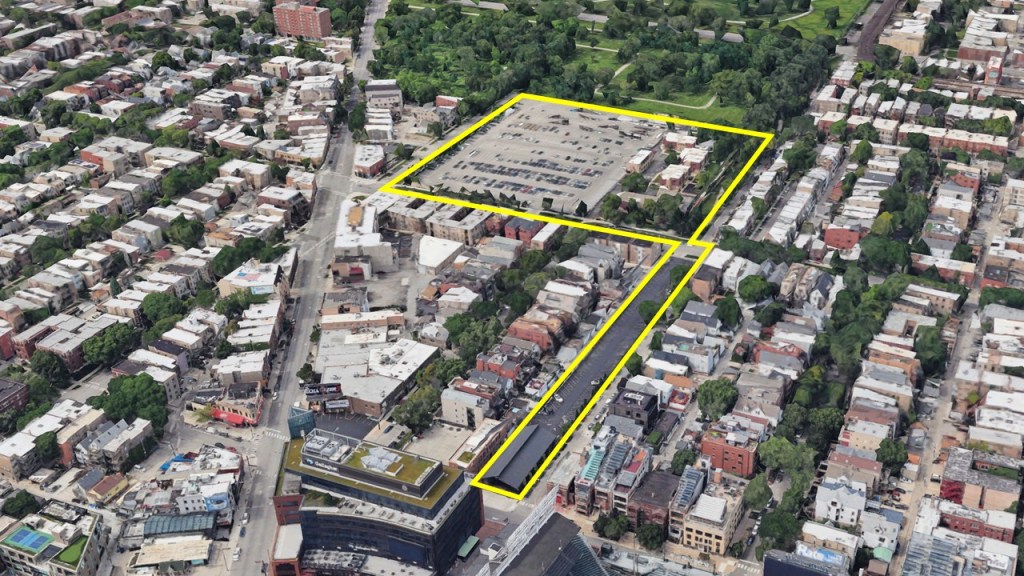
CHICAGO — October 15, 2026 — The Chicago Plan Commission has approved a revised proposal by the Chicago Cubs to expand the team’s surface parking facilities near Wrigley Field, potentially adding up to 219 parking spaces along with landscaping and other site improvements.
The approval, announced Thursday by the Chicago Department of Planning and Development, concerns the Toyota Camry parking lot near Racine Avenue and Grace Street in Lake View. The revised project incorporates property formerly occupied by the House of the Good Shepherd, a longtime residential shelter and social services facility.
The city’s announcement describes the project as an expansion of a 581-space surface parking lot, with a maximum of 219 additional spaces, bringing the site to an authorized capacity of 800.
The decision follows months of discussions among the Cubs, neighborhood organizations, residents and 44th Ward Alderman Bennett Lawson, who announced earlier this month that he would oppose any expansion beyond the 800 parking spaces already permitted under existing zoning.
What Was Approved?
The October 15 announcement represents a scaled-back version of the Cubs’ earlier proposal, which would have increased parking capacity to approximately 940 to 947 spaces.
According to the city’s announcement and the revised Planned Development 108 proposal, the project includes:
- Up to 800 parking spaces within the main Camry Lot development area.
- Incorporation of land formerly occupied by the House of the Good Shepherd at 1114 W. Grace Street.
- Demolition and redevelopment of the former institutional property for parking.
- Additional landscaping and trees.
- Changes to the development’s boundaries and site configuration.
- Inclusion of an existing parking area with up to 103 spaces in a separate subarea.
- No proposed changes to the public park designated as Subarea B.
Although Thursday’s announcement uses a baseline of 581 spaces, earlier statements from the Cubs and Alderman Lawson described the operating lot as having 688 spaces. These figures reflect different reported parking counts and should not be treated as interchangeable.
The key limitation is that the main lot’s approved capacity remains 800 spaces rather than the larger total the Cubs previously sought.
A Proposal That Faced Strong Neighborhood Opposition
The Cubs first presented their parking expansion plans to East Lake View Neighbors in March 2026.
At the time, the team proposed substantially increasing the number of parking spaces by incorporating the former House of the Good Shepherd property into its existing parking facilities.
Cubs representatives argued that additional parking would reduce the number of visitors looking for spaces on residential streets around Wrigley Field.
Their position was that the additional capacity would serve existing demand rather than attract more vehicles to the neighborhood.
However, many residents questioned whether adding hundreds of parking spaces near an already congested entertainment district was the appropriate solution.
Concerns included traffic congestion following games and concerts, pedestrian and cyclist safety, increased vehicle activity on Grace Street and Racine Avenue, and the long-term use of valuable neighborhood land for surface parking.
The issue also raised broader questions about transportation planning around Wrigley Field, which is already served by CTA trains, buses, bicycle infrastructure and pedestrian routes.
In earlier reporting, the Cubs indicated that approximately 63% of game attendees used transportation other than a personal vehicle, while 37% drove.
Alderman Bennett Lawson Draws the Line at 800 Spaces
On October 1, Alderman Bennett Lawson announced that he would not support the Cubs’ request to expand beyond the parking capacity already permitted under existing zoning.
Lawson cited strong resident opposition and the need to address traffic and public safety before allowing additional parking beyond that limit.
The alderman explained that the existing planned development already authorized up to 800 parking spaces. Consequently, the Cubs could pursue a revised site plan within that limit without requiring his approval for additional parking capacity.
The Cubs also were required to advance amendments to Planned Development 108 addressing outstanding issues involving the Clifton alley, the Blue/Highlander parking lot and security improvements associated with Wrigley Field.
Lawson emphasized that the city and Cubs needed to demonstrate improvements to the neighborhood’s traffic management system before he would support a larger expansion.
The Cubs have been working with the Chicago Police Department, Chicago Department of Transportation and Office of Emergency Management and Communications on updates to the Wrigley Field Traffic Management Plan.
That plan, according to Lawson, had not undergone a comprehensive update in more than a decade.
The October 15 approval reflects the revised project moving forward within the existing 800-space cap.
The Former House of the Good Shepherd: More Than a Parking Lot
One of the most significant aspects of the project is the transformation of the former House of the Good Shepherd campus at 1114 W. Grace Street.
For more than a century, the institution served women and families facing difficult circumstances, including domestic violence and housing instability.
The organization operated at the location beginning in 1907. Its original buildings were eventually replaced with more modern facilities in the 1970s.
The property was later owned by Catholic Charities of the Archdiocese of Chicago, which moved the shelter and its programs to another location.
The Cubs purchased the property in 2024.
Demolition permits for three buildings on the property were issued in April 2026, and demolition activity began later that month.
By May, portions of the former campus had already been removed.
The loss of the campus represents a significant change in the history of this part of Lake View. A property that once provided residential services and support for vulnerable women is being incorporated into the transportation infrastructure surrounding one of Chicago’s most prominent sports and entertainment destinations.
Landscaping, Trees and Stormwater Management
The Cubs revised their plans during the community review process to address several concerns raised by residents.
Those earlier revisions included additional landscaping along the parking lot perimeter, trees within parking areas and measures intended to reduce the environmental effects of a large paved surface.
The team also proposed retaining portions of the former Good Shepherd building basements for stormwater management and installing permeable pavement in sections of the expanded lot.
Additional modifications focused on lighting and traffic circulation.
The Cubs proposed a new exit on the western side of the parking lot to help direct vehicles toward Clark Street rather than through residential portions of Grace Street.
Other proposed changes included directing vehicles exiting onto Grace Street westbound toward Clark Street.
The precise landscaping, drainage and circulation measures contained in the final approved site plan will determine how these commitments are implemented.
What About Kelly Park?
The proposed development is immediately adjacent to Kelly Park, an important neighborhood green space.
According to the planned development description, the public park occupies a separate subarea, and no changes are proposed for that portion of the property.
Previous Cubs presentations also stated that the parking lot expansion would not encroach on Kelly Park.
The proximity of the expanded parking facilities to the park remains relevant to neighborhood discussions about trees, open space, traffic and the pedestrian environment.
The 2027 MLB All-Star Game Adds Another Dimension
The timing of the parking lot project comes as Wrigley Field prepares to host the 2027 Major League Baseball All-Star Game.
The event is expected to bring national attention and substantial visitor activity to Wrigleyville and the surrounding Lake View neighborhood.
Throughout the planning process, the Cubs have discussed transportation, security and traffic-management improvements in connection with major events at Wrigley Field.
The revised planned development also addresses security-related improvements associated with the All-Star Game.
While the event adds urgency to infrastructure planning, the proposed parking changes would have a much longer-lasting effect on the neighborhood.
More Parking or Better Transportation?
The debate surrounding the Camry Lot highlights a question that extends well beyond Wrigley Field: How should established urban neighborhoods accommodate visitors without becoming increasingly dependent on automobiles?
Supporters of additional dedicated parking argue that it can reduce pressure on residential streets and create more predictable arrival and departure patterns.
Opponents counter that increasing parking supply near major destinations can encourage more driving, contributing to traffic congestion and conflicts with pedestrians and cyclists.
Wrigleyville is different from many modern stadium districts because Wrigley Field sits within a dense residential and commercial neighborhood rather than being surrounded by vast parking facilities.
That setting is central to the neighborhood’s identity and economic activity.
Businesses along Clark Street, Addison Street, Southport Avenue and surrounding commercial corridors benefit from the crowds that Cubs games, concerts and special events bring.
At the same time, the neighborhood must accommodate the everyday transportation needs of residents, workers and visitors.
Finding that balance will remain an ongoing challenge.
What Happens Next?
Thursday’s Chicago Plan Commission approval is an important step in the Cubs’ revised development proposal, but it should not be confused with confirmation that every remaining permit, administrative approval or construction requirement has been completed.
The revised planned development establishes the framework for the site and its permitted uses.
Remaining steps may include subsequent zoning actions, final site-plan administration, permits and implementation of traffic and landscaping measures.
A definitive construction completion date for the newly configured parking area has not yet been established in the materials reviewed.
A Changing Wrigleyville
The Cubs’ revised parking lot approval represents another chapter in the ongoing transformation of Wrigleyville.
Over the past decade, investments surrounding Wrigley Field have changed the area’s hotels, restaurants, entertainment destinations, public spaces and transportation patterns.
The former House of the Good Shepherd property is now part of that larger transformation.
The October 15 approval shows that the Cubs can move ahead with additional parking within the existing 800-space authorization, even after the larger proposal encountered significant community resistance.
Whether the revised design succeeds in reducing neighborhood parking pressure without worsening congestion will depend on its implementation and the effectiveness of the city’s updated traffic-management strategy.
For Lake View residents, the bigger question remains whether future development around Wrigley Field should prioritize more places to park or better ways to travel through the neighborhood without a car.
What do you think? Does Wrigleyville need more dedicated Cubs parking, or should the neighborhood focus on public transportation, pedestrian safety and green space? Share your thoughts.
Sources and additional reading
- Chicago Department of Planning and Development — October 15, 2026 announcement
- 44th Ward — Cubs Camry Lot Project and Alderman Lawson’s October 1 Statement
- Chicago Sun-Times — Cubs Parking Expansion Proposal, March 2026
- Chicago Sun-Times — House of the Good Shepherd Demolition, May 2026
- Chicago YIMBY — Demolition of Former Good Shepherd Campus
- East Lake View Neighbors — May 2026 Community Meeting Agenda

